

Thank you Cat: Poli-Psych, PJ Schuster, Dr. Susan Mayne, Donna Everett, Patricia Scott, and many others for tuning into my live video with Laurie Cantillo! Join me for my next live video in the app.
Laurie Cantillo stops by to talk about Humane Borders mission and to give us an update on the border. Contrary to what the media and administration are telling us, the border is not closed nor sealed as they claim. Pima County, Arizona reports 19 deceased migrants found in July 2026 alone.
Transcript:
Jenn: So, we’re getting started here. Today I wanted to, you know, usually I do a lecture, but the last two times I’ve had people I wanted to talk to, and - my dog’s playing on the ground if you hear hacking and stuff. She’s rolling around deciding now’s the time to play. But you sent me a message, and they said, well, I’ve got to have you on then, on a live. We have to talk about this.
Once again, on Borderland Talk, we have a live guest, and this is Laurie Cantillo of Humane Borders. And I have supported, gosh, I don’t know how long I’ve been supporting you all. I know I’ve done a couple of trips down there to the Tucson border area where you’re mostly situated. And we’ll talk about your organization and stuff and give everybody an idea of what it is that you do. And then we’ll talk about the message that you sent me and why that’s so important.
How does that sound to you?
Laurie: All right, perfect. Thank you, Jenn. I’m happy to be here.
Jenn: All right. Well, and thank you for being here. So like I said, I’ve supported Humane Borders for a while now. They’re a nonpartisan organization and they’re mostly supported by private donations and volunteers. I’ve been fortunate to be able to go out on a couple of trips with them in the Sonoran Desert. Which if you have not been to the Sonoran Desert, it is beautiful, but it is god-awful hot. And sometimes it has downpours during the monsoon season. I think y’all are in monsoon season right now, aren’t you?
Laurie: Oh, absolutely. We’re getting some big storms and erosion and mud to deal with on top of everything else with this god-awful heat and humidity.
Jenn: Yeah, it’s a little humid over here in San Diego, but obviously not as much. I can tell it’s raining out where I used to work in the mountains just by the clouds, but it’s not been too bad here in the city.
And you all operate a bunch of water stations, big old barrels along the southern border in different areas. But you also maintain maps on your website at humaneborders.org. and that identifies thousands of migrant bodies that have been found over the years. These deaths are the result of the U.S. policy called deterrence that was enacted by democrats under the Clinton administration in 1994. It is estimated that this policy has intentionally sent at least 80,000 people to their deaths. Untimely deaths. And it has been a complete failure because as we know, deterrence does not work and has not stopped anybody from crossing illegally.
So let’s first, let’s talk about the water barrels and what all it is that you all do and how that helps people out there, first.
Laurie: You bet. Again, I really appreciate the opportunity to talk with you and your viewers and your support of Humane Borders all these years and going on water runs with us, which we welcome. Anyone who’s interested in going out with us, please reach out at info at humaneborders.org.
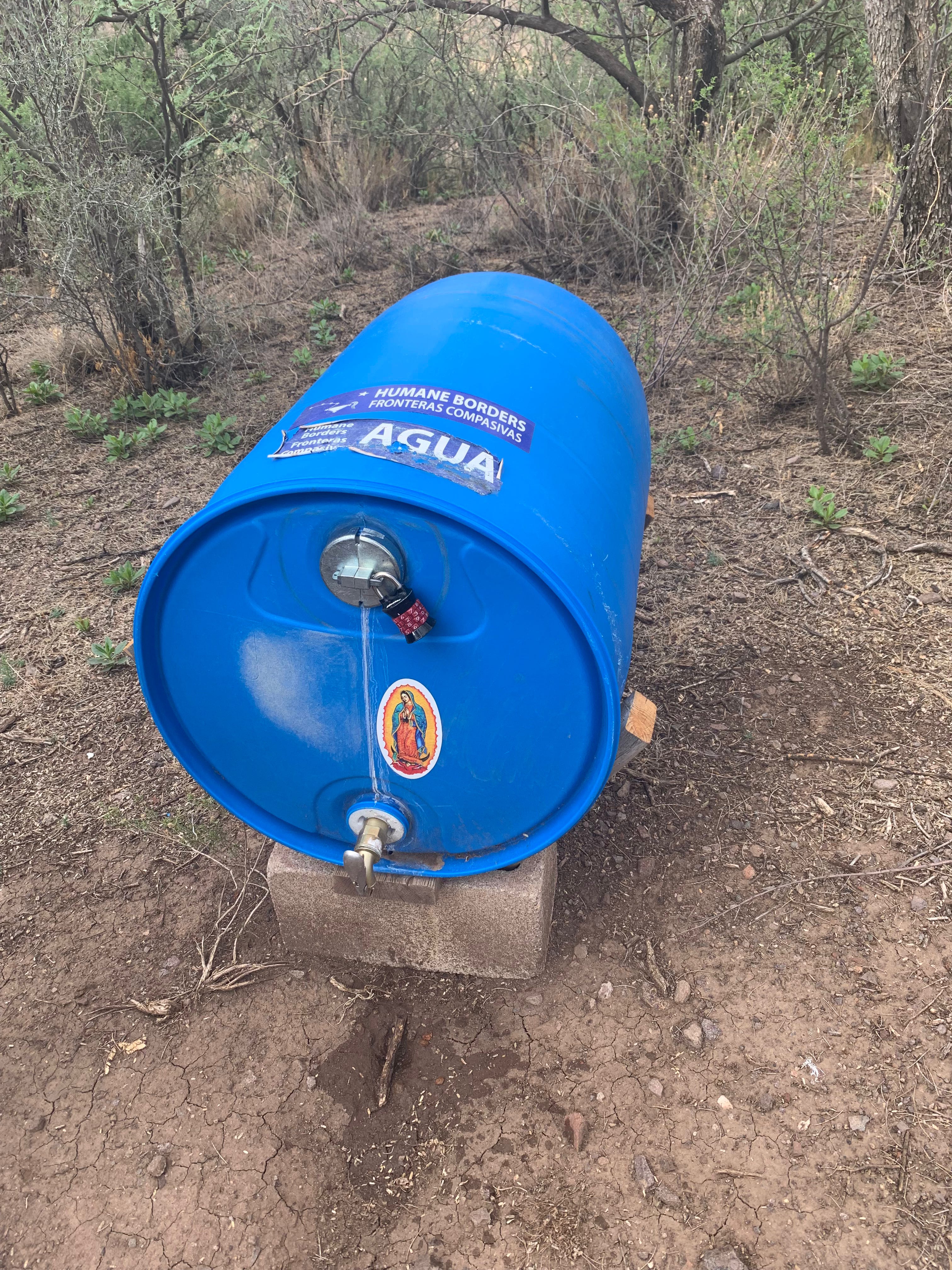
So we were founded in the year 2000, which is when we really started to see an increase in migrant deaths in Arizona. And it was a group of faith leaders who got together and said, not in our backyard. So they decided to start working on a system using 55-gallon blue barrels and blue flags, with blue being the universal symbol of water, and they’re all permitted.
We work with both government officials as well as private property owners who don’t want to see people dying on their ranches to put these stations out. And we locate them based on a couple things: where people have recently died as well as our ID hikes that we take regularly in the desert and we’re looking for not only people in distress, but migrant remains or migrant belongings, things like camouflage backpacks or what they call carpet shoes to hide footprints in the desert. So, that informs where we put our water stations. We’ve been doing it, as I said, 26 years now.
The founders thought when this originated that this will be a few years and then we’ll get on the other side of this. Surely the government’s going to see that prevention through deterrence policies are causing people to die by the hundreds in the deserts. But actually, those deaths were somewhat intended consequences of prevention through deterrence, which essentially says, no, you can’t come in through safe ports of entry. But this creates a funnel effect, which forces people into increasingly remote and dangerous areas right in the center of Arizona.
And the reason I reached out to you recently is that I was disturbed when I looked at the July data that we cooperate with the Pima County Medical Examiner and saw there had been 19 new records for just the month of July. And that is the highest month that we have seen in two years. Certainly, there have been other occasions where deaths have been high, but this is the highest in recent memory. And so we’re trending to be well over 100 deaths again in 2026. And I’m offended by that because it’s right in my backyard.
Jenn: Well, Laurie, are you sure about this? Because I’m pretty - I’m being sarcastic - because I’m pretty sure that the Trump administration has said that the border is closed and sealed right now and nobody is crossing. Laurie, are you telling me that they are lying?
Laurie: (laughs) Um, I think they’re playing a little fast and loose with rhetoric there by saying the border is, quote, closed. They’re trying to send a message, of course, to migrants who might want to take the risk. But I actually monitor the CBP’s own apprehension data, and in the last couple of months, we’ve noticed it averages around 10,000 a month across the entire southern border. It’s been upticking to 12,000, 13,000. So what we’re seeing is more people chancing it and therefore more people dying in the desert, especially in these triple digit temperatures that we have.
Jenn: You know, there was an interview with one of the L.A. Taco guys, I think the main guy that everybody knows, and I can’t remember his name off the top of my head, and he had said, you know, they already know people that were picked up by ICE in L.A. in the beginning of the ICE raids, and they are already back within months. And when this all started, I was like, they’re absolutely lying to you all. At least here in San Diego, we were seeing checkpoints that were actually kind of intermittently shut down. And that’s because they’re sending all their agents into the cities. When you close your checkpoints down, then you have no idea how many gotaways you have. All of a sudden, as soon as Trump was sworn in, they were like, oh, there’s no gotaways. Nobody’s crossing. It’s just absolute bullshit. It’s just absolute bullshit.
And the one thing that we know in the Border Patrol and in CBP is that if you do not give people legal avenues with which to cross, they will cross illegally every single time. That’s what MPP and Title 42, when they shut down the asylum system. And so as soon as they started this, it’s like you can take people out of the cities and a lot of them will - and deport them or expel them - and some of those people will stay away. But especially the people who’ve been living here for 20, 30, 40 years, they’re going to come back. They have nowhere else to go.
And so it’s - but what I find interesting is is that. I haven’t seen, now are they talking about it locally in the news over there in the Tucson area? Are they reporting Border Patrol has found any of these deaths or are they just not talking about it at all?
Laurie: Locally, people who are in communities along the border are well aware of this challenge. I would say the rest of the country has no idea. In our database, we have now 4,505 records in the last 26 years. And I want to point out that, yes, these are mostly younger men who are of working age.
They either want to improve their lives economically or They’ve been deported and they want to get back to their wives and kids. Who can blame them, right? Even if it is 117 degrees. So that is unfortunate, but also there are women and kids dying out there as well. And that’s heartbreaking for everyone.
And I want to point out that the water security is not only for migrants. We’ve had several Border Patrol agents come to us and say, Hey, do you have some extra water? I had a leaky water bottle or a guy on horseback who showed up and asked for water and thank us because it makes their job easier. And you know this, if you don’t have to process human remains and go through all of that trauma, but you can have an apprehension rather than a death. And we like to say that the desert should not be the judge, jury and executioner of people. They need to be, if they’re apprehended, put them through the legal process. Let them have their day in court. But to condone deaths of human beings, men, women, and kids in the desert is just heartless and it’s wrong and it’s not what my version of America is about.
Jenn: I see here Sunny is asking, they said, don’t the dead body counts have to be documented by the feds, the gender, the age? No, they have not been documenting it for decades. And what Laurie is talking about with Humane Borders, when they started to see this uptick in the year 2000, so that was right when I was leaving the Border Patrol. I was stationed just to the west of where Laurie is by about, well, Tucson’s about six hours from San Diego, let me say about five hours from where I was out in East County. And Operation Gatekeeper had pushed the migrants out into this desert that Laurie is talking about. And then, yeah, the timing that you’re talking about, we knew that that area, Tucson, was having a lot more crossings. Yuma was having a lot more crossings. And the idea from the Border Patrol flat out said, they must suffer.
The idea of deterrence was to push them out, push the poor migrants out that we would not allow to enter legally as they would like to, push them out to the most dangerous areas to cross. And that the deterrence would be that they would suffer emotionally, mentally, and physically and then not try again and call their relatives and say, don’t make this trip.
And it has never worked. It started in 1994. If it worked, it would have worked by now. We wouldn’t have all the problems that we’ve had. And the fact is, is that when people have nowhere else to go, you know, their only choice is: Am I going to die in Mexico? Am I going to die in Colombia? Am I going to die in Honduras? Or am I going to just try and make it? And they oftentimes have relatives here who have made it over the years or who are here legally. And so they have no other choice.
And Laurie is absolutely right. These water barrels do save everybody’s lives, not just migrants. They save agents’ lives. I can attest to that. And they save hikers’ lives as well. And they are very important to have out there.
My question is, is so the other thing that we saw in the last couple of weeks is, and we’ve seen it since Trump’s come back in office where he’s created these national defense zones.
Laurie: Mm-hmm.
Jenn: And this is where the military has taken over certain parts of the southern border. Just recently, they’ve stated they’re going to extend it all the way across the southern border, which is más o menos, it’s about 2,000 miles. It’s humongous. And essentially, so from an operational standpoint, the reason why they’re doing this is, there’s a variety of reasons. One is they’re taking Border Patrol agents and sending them to your cities so that they can then do what they do down here on the southern border, which is ram your vehicles if you’re a person of color and they think that you might be undocumented, which means you’re brown, so they’re racially profiling you. So they’ll ram your vehicles, as you’ve seen. They’ll pull out their guns and shoot anybody who is protesting against them. They are apparently now going to be enforcing election integrity, which they have no legal justification to be able to do. But that is done so that then they can take the Border Patrol agents down here and put them into the interior.
At the same time, and this is an assumption on my part, and I’d like to get your opinion on this, Laurie, is...I kind of feel it’s also to hide the fact that people are still crossing and to float this idea that nobody’s crossing and the border is sealed and we’re all safe, number one. I think it’s to keep humanitarians out like yourself so that you’re not documenting humanity. The amount of people who are crossing, the amount of people who are dying, and what the Border Patrol is doing to them. And I think it’s just the further militarization of our border as well. What are your thoughts on that?
Laurie: Yeah, I hardly recognize the borderlands anymore. I used to own property near the border and remember how friendly it was, and then I could just walk over into Nogales and shop for the day and have I’d have lunch at La Roca and have my son sit on a donkey with a sombrero and come back. And people from Nogales, Mexico would come to Nogales, Arizona and shop at the Walmart and go home. And everybody was happy and it was fine.
But now we have not only single walls, but double walls being erected in areas where people don’t even cross. There are wildlife cameras in the San Rafael Valley, for example, where the movie Oklahoma was filmed. It’s wide open space. You’d be crazy to cross there. Plus, there are no roads on the other side leading there from Mexico. So we’re seeing double walls. In some places, there’s plans for triple walls. And you’ve seen all of the coverage of the tree sitters for the cottonwood trees in the San Rafael Valley and what’s happening in Big Bend with protesters.
But I think you’re right about one thing that is totally out of sight, out of mind, is what’s happening to the Tohono O’odham Nation, our neighbors to the west, who are supposed to have sovereignty, and our government has promised them for decades that they would never put a wall there. Well, guess what? Now they’re in the gun sites for the next border wall. And the double wall planned for Oregon Pipe, which is a national park. So it’s not just Big Bend. Roads have been closed there. They want to go right through the middle of a sacred spring that has endangered species. And what we’re also seeing is concertina wire. Usually you see concertina wire on the top of barriers, but in this case they’re just rolling it out by the miles right on the ground, which I don’t know what the purpose of that is, but it serves to be a terrible hazard for wildlife. If you get animals caught in that concertina wire, they are not coming out alive. There was a photo of a bighorn sheep in California that had the misfortune of getting caught up in this wire.
And we see tanks. We see military helicopters. Recently, they have started buzzing, meaning flying low, right over people who are protesting, kicking up rocks, kicking up dust. Some of those protesters are planning to file a complaint with the FAA about this. So now, they currently have six national defense areas, and they’re usually connected to a current military base. But then they have this 60-foot Roosevelt easement all along the border, all along the wall. That is the property of the federal government and they are claiming these as military zones.
What is the purpose? I can only speculate that It turns a migrant crossing that is normally a civil misdemeanor into a criminal act. So there’s another charge that they face. They don’t mark these areas well. So last I read, there have been 161 people caught up, whether intentionally or unintentionally, walking in these areas. And you’re right. I believe it’s a way to bypass posse comitatus, which says we’re not going to use our military against our own people. So that’s what we’re seeing in our beautiful borderlands. It is a construction zone and it’s heartbreaking to see.
Jenn: I will say in the past, even as an agent in the mid-90s, I got in 1995 and I left in 2000. 2001, I should say. Right before 9-11. And both sides, both republicans and democrats have been using the military down there. When I was an agent, Clinton used the Army Corps of Engineers to build that first wall that we saw going from San Diego all the way out. And then we also would, and I don’t know whether it was ordered or legal or we were just doing it because, you know, like nobody checked on us. We could do whatever we wanted to. We would send, have the military run the scope trucks, the night vision trucks for us and then they would call out where they saw the groups and things like that. We could then as they would call that, a force multiplier kind of thing.
And so they were already doing that kind of stuff. But what is different now is they’re allowing them to arrest and detain them. And that’s where we get into that Posse Comitatus Act violation. But I saw that, and you had sent it to me too, that on August 15th, most recently, the Department of Justice has expanded the military’s jurisdiction, meaning their powers on the border. They’ve issued a legal opinion, not a law, not a policy, just an opinion that the Trump administration, you know, in these areas that they’ve created that they call national defense areas, NDAs, all along the southern border and that’s done in an effort they claim to deter illegal immigration. But as I said, it doesn’t deter illegal immigration. But I don’t really think that that’s what it’s about. I think something else is going on because I don’t understand why they need to expand it. So now they’re saying…the military can now have arrest powers outside of the national defense areas. And I’m like, wait, what? So are they going to be going into the cities? Are they going to, you know, are they going to pursue people? Like say this group crosses and they chase them and they go outside of the national defense area, then they can go and still go after them and arrest them? Does that mean the military is going to be doing pursuits? And it just feels like they’re starting to push and push and push and give them more what we would call jurisdiction or area of authority.
And I think that’s beyond scary to me that they’re training the military to do this. And then obviously we see the military in our cities, so I don’t think that’s an unreasonable assumption or presumption on my part. Do you have any thoughts on that, Laurie?
Laurie: I think much like migrant deaths, people, it’s almost become normalized. I hate to say it, but there was a time when I could say that five people died last month in the desert and people would pay attention and there would be headlines. And now when we say every month it’s 10, 12, you know, 13 in June, 19 in July. It’s not just red dots that we’re talking about here. These are someone’s son, brother, dad, you know, sister, child.
So, and I think the militarization is unfortunately becoming normalized as well. You know, we see the lengthy deployments in D.C. that many are questioning. Why are they still there? We’re seeing more masked, you know, mostly men in our cities. And in Tucson, about a week and a half ago, there was a tank-like vehicle that showed up with an ICE raid, something that you would associate with the military operation.
We’ve been approached at water stations several miles north of the border by individuals in unmarked vehicles with out-of-state plates, wearing camouflage, and they are not identifiable as members of the U.S. military or the Border Patrol or Homeland Security investigations. There’s no identification. So we don’t know whether we’re dealing with a legitimate law enforcement or military person or whether these are vigilantes who we tend to run away from because they usually want to harass you, propagandize what you’re doing and live stream it or vandalize our water stations, which unfortunately just happened a couple of days ago.
So, I think it’s an effort to see how much people will tolerate and also how much we’re all paying attention. Because remember, this was about kind of flooding the zone. And if we’re paying attention to everything coming from 10 different directions, we become overwhelmed. And it’s hard to focus on the one thing that we should all be focusing on, and that’s on civil rights and the fact that people are dying in the desert.
Jenn: I think that’s a really important thing that I hadn’t even clued in on is because this area, the Tucson area, the Sonoran Desert, has had quite a history from the first Trump administration and then especially in the Biden administration of these militias going down there pretending that they’re Border Patrol agents. These, as you say, like online camera guys, I used to call them... Steve Bannon Bros, Border Bros. They helped sell the invasion that Donald Trump’s policies created during the Biden administration, where, you know, unfortunately, the democrats continued the shutting down of the asylum system for the first three years of the Biden administration, which caused so many people to cross illegally. And that was done on purpose so that they could then send these bros down there with these militias and video everything. And so they were producing all of this content, which created this idea of there are open borders, even though there weren’t any open borders. And then they were selling that also in Central America and stuff, telling migrants to come, that the Biden administration would allow them in. And these guys would come out And filmed themselves on the border with migrants. A lot of them, quite frankly, and this is just my opinion from my experience, feel like predators. I saw them engaging with children, female children and stuff. And it shocked me quite a bit to see the interactions that they were having with these young girls and their behavior. So, I wouldn’t be surprised if there were problems with that.
And so... when you’re saying that you’re in Tucson or down further south by Sasabe and places like that in the Sonoran Desert, you have absolutely no idea. Is this a military person coming at you? Is this one of these border bros from back in the day? Are they filming more content? Are they malicious? Are they white supremacist militias? Because I know they were harassing the Green Valley Samaritans and No More Deaths at the same time, too. So that’s got to be really terrifying for your people, your volunteers that you have out there that are just trying to put water in the desert.
Laurie: It is. It’s much like the argument about masks and police in our cities that you can’t tell. Is this ICE? Is this Border Patrol? Who are these people? Or is it some random kidnappers that are disguised as an ICE agent? And we’ve seen this happening where we have ICE impersonators going around the country and kidnapping and robbing people. So... it’s really important that we have regulations and some local governments are doing this where - no masks, you know, and you have to have clearly identifiable a patch, an emblem with who you’re with, what your name is, what your badge number is. And that’s transparency, and that’s what we need right now. And it’s certainly not happening at the border. My heart just goes in my throat when I say, When I see an unmarked vehicle coming and there’s people with camouflage and they’re carrying semi-automatic weapons and in some cases they follow us, they harass us.
We don’t know whether our lives are in danger. Well, we have constant communication now via satellite so that we can call 911 immediately if we have an issue. We have dash cams in our vehicles. We have protocols developed of what do you do if you’re approached by someone and you don’t know who this person is. So it’s sad that just something as innocent as putting water out to save people’s lives turns into, for some, this super hyper-political thing. We are a nonpartisan organization, and if there’s problems that the democrats have initiated, we will call that out, as much as with the republicans. Unfortunately, back in the day, there was not much difference. It was shades of gray between them. In terms of deportations. Of course, now the rhetoric is sky high on one side of the aisle. But we always look at things through a humanitarian lens, not a red versus blue. It’s really about what’s right, not right versus left.
Jenn: Yeah, and I will say, I do actually know, I know Republicans who drop water in the desert over here in Imperial and… in the El Centro area and stuff like that. And they’ve been doing it for many, many, many years. They will tell you flat out, you know, I think everybody should cross legally, but I also don’t think people should die for crossing a line in the sand. And so, it’s a unique kind of community that we have with our water droppers and food droppers. So it’s very interesting.
Laurie: Yes, I agree, Jenn, and I want to just give a shout out for our fellow humanitarians. You mentioned the Samaritans. We have Tucson Samaritans, Green Valley, Ajo, and No More Deaths, and they’re doing the water and food drops in the desert, so they’re hiking in supplies. We use the large water trucks with the larger scale water operation. And we all coordinate, work together, and we have a common goal, and that’s saving lives.
Jenn: And a lot of those Samaritans are senior citizens. The Green Valley Samaritans are. I know a lot of the Tucson Samaritans are. I ran into them when I was with the Green Valley Samaritans. I was out there with my friend Barb Lemmon out there, who I love to death. And she’s now retired from that. And we ran into some Tucson Samaritans. And they said, oh, we heard about this on NPR one day. And I said, well, that’s where we’re going to retire to my husband. And so now we’re down here doing this and we’re dropping water. And I’m like, y’all are seriously committed to move down here and do this in your retirement. That’s insane. But I just, yeah, the Samaritans are some of the most amazing people that I’ve ever met. And I just absolutely love them.
These national defense areas, though, the militarized zones, How’s that affecting your water barrels? Because I know for a while, I remember over in the Ajo area, I believe you had some right up pretty close to the wall there. So how does these new military zones that limit, like I’m assuming civilians can’t go in these areas either anymore. You can no longer drive the whole southern border on the border road.
Am I correct in that?
Laurie: That’s being tested. I saw a funny video today of a guy who decided in New Mexico to go jogging along the border wall road and one agent just drove by and kind of waved at him and then the next one stopped him and said, hey, you can’t do this, dude.
We don’t drive the border wall road and haven’t for some time. We did have some temporary stations out at Organ Pipe, and that was when asylum seekers, mostly families, were crossing. A lot of medical problems. Women who were pregnant, nursing, had little ones with them. That was a scary situation, to be sure.
And I want to point out, they were crossing through the wall. So anyone who thinks that the wall is the answer to, quote, border security hasn’t seen. Go on YouTube and Google border wall cutting and you’ll see that smugglers using metal saws with a generator. Right off of highway two in Mexico, they pull off and in three minutes they cut through the bottom of the bollard or the vertical beam on the border wall and then it swings open and everybody comes pouring through. I’ve witnessed it myself. I’ve also interviewed a welder who was telling me he repairs from three to fifteen wall cuts a day.
Jenn: Yup. It’s job security for them. (laughs)
Laurie: They say that. They brag it’s security for life, and I have that on video with one of them saying job security for life. So if we acknowledge that the wall isn’t the answer, then are two walls the answer, three walls? I mean, if it takes three minutes to cut through wall number one and then another three to go through wall number two, you might buy three minutes for the Border Patrol to get there. But even Texas border sheriffs who are republicans are arguing that border barriers are not the be-all end-all.
But in terms of our stations, we don’t currently have stations right at the wall with the exception of a couple that are on private land. So we have permission of the ranchers and they are both republicans and democrats because people who live in the desert know that you don’t deny water to anyone. And so those are safe. Those are on private land. We access them through private land. And currently the military zones go about three miles north of the border. Most of our stations are well beyond that because that’s where people really start to run into trouble is about 10 miles, 20, 30, 40, 50 miles out. So that’s where we muster most of our resources.
Jenn: Hmm. Yeah, the walls, so for people who don’t know, the walls will fall down within five years without constant maintenance. And then in the areas like what we’re talking about in the Arizona desert and the Sonoran desert and in the Chihuahuan desert on the other side, closer towards El Paso, when you get the monsoon season, you have to have gates that you legally have to open up or else the water will rush down their arroyos and knock the whole thing down. And so it’s a constant fight.
But yeah, you can get a metal grinder from Home Depot. I don’t know how much they are now. They used to be about $25. And you can get through those walls really quick. I’ve seen them do it so fast. And down here in El Centro, a couple years back, actually, when Chief Gregory Bovino was the chief down here, they had two giant SUVs come through. And there was a camera within 100 yards watching the whole thing. And an agent stationed within 200 yards away watching the whole thing. And they just went flying on through. Unfortunately, one of the vehicles ended up in a horrible crash and
killed thirteen people in Holtville. But, you know, so it doesn’t stop anybody from crossing. They just cut it or they bribe an agent to look the other way. They don’t monitor the cameras. And, you know, and when they get through and you’re like, well, can you explain how your excellent wall, your cameras, and your agent let all this happen? Then they won’t talk about it and stuff. So the walls are a waste of time.
Down here in San Diego, right closer to the beach, we have three walls. Three walls, one right after another. And they constantly are having to rebuild it. The one that extends here into the ocean, they have to rebuild it because salt water will eat away steel every single time. And so they have to rip it out and then keep rebuilding it. And it’s essentially... you know, the contracts have gone to friends of Donald Trump in the most recent years. And it’s just a payback. It doesn’t stop anything.
I think one of the things I noticed about the Sasabe area, which is kind of south Tucson, basically, is that - what the people were telling me out there, the Green Valley Samaritans were telling me out there, is that this whole area didn’t have a wall and there wasn’t a whole lot of crossing going on because it is so dangerous. So the terrain itself was a deterrent to crossing kind of like the Big Bend area that they’re talking about in Texas now. But no, Donald Trump had to have his wall out there, and so they started blowing up the sacred mountains out there that belong to Native American communities out there, whose communities extend south across the border, and they’re supposed to be allowed to go back and forth within their own territory, within their own sovereign nation, but they can no longer do that. And one of the things that the Samaritans said was, in order to build this wall, they then have to create all the infrastructure and the roads to get to the border which did not exist before which then actually increased the people being trafficked because now you’ve built a system where people can drive cars and then smuggle people. So, they just created this on their own and it didn’t exist before. Nobody was wanting to - few people were wnating to cross out there. I don’t want to say nobody, but few…
Laurie: Yeah, the smugglers are like, thank you very much. You put roads in so it’s really easy for someone from Phoenix to drive down and do a pickup and there you go. So there’s not a whole lot of thought behind this. It’s much like near Sasabe, this little town and port of entry between Arizona and Mexico, they painted the wall black. You probably remember this.
Jenn: I went and saw it, yeah.
Laurie: But you’ve seen, there was actually field testing done where you put a thermometer on the raw steel versus the painted black. And guess what? The raw steel is much hotter. But the intent was to, don’t get me started, to make by painting it black, it would be hotter, therefore scalding the hands of people who try to cross. And it just makes me think. What’s next? Boiling vats of oil? Really? Is this the best we can do right now for our country? Why don’t we take these billions of dollars that we just keep shoveling into more walls, more infrastructure, and reform the immigration system? Give people a way to voluntarily come and whether it’s for employment or whether it’s for asylum or to reunite with your family, that doesn’t take twelve, twenty years to do. That’s, in my opinion, the solution.
And yet what we’ve seen the last couple of years, there’s a Cato Institute report that said illegal immigration has been stopped two and a half times more than - I’m sorry, legal immigration has been stopped two and a half times more than illegal; immigration. And I believe that’s why we’re seeing so many people crossing now, because it’s hopeless. There is no legal way anymore unless you’re rich or you’re white from South Africa.
Jenn: (laughs) That is true. I did actually, one time I was out there and I did see the black painted wall. And that was Trump’s idea because he thought if it was black, it would absorb the sun more. And I was like, huh. Well, I mean, what I noticed was there was black paint overspray on everything around there, first of all. So all over the natural habitat and everything. And then I was like, okay, let’s see if it’s hotter. And I went and touched it. And I’m like, it’s actually cooler. What? What? It actually protected it and it made it cooler.
The other thing that they could do is you could build this $5 billion wall and you could go to Home Depot and buy, you know, like yellow twine and you wrap it around the bollards in a circle eight. And then that creates a step and you just, and you can just go up, go up it really fast. And so, I mean, there’s just, there’s, there’s…when they started building this, I was like, those walls aren’t for migrants because migrants can cross walls. They’ve been crossing walls forever.
Laurie: Yeah, they can climb them. We see ropes a lot.
Jenn: You know, it’s for fat-ass Americans like me. They’re trying to keep us in here. And I used to joke about that, but now I’m kind of like, hmm.
Laurie: Yeah, it’s a lot of performative work down there. I think if you ever, it’s pretty revealing to follow some of the, if you can, CBP and DHS social media accounts and see how, you know, they’re turning blowing up national parks into, you know, something real badass and macho and tough and so forth.
But that black paint near Sasabe is peeling. It peeled almost immediately, much like the bottom of the reflecting pool. So I think we, it’s just, if it weren’t so serious and so wasteful of our tax money, it is almost funny, but it’s not because it’s our cherished borderlands that are at stake here.
Jenn: I think, you know, getting back to the reason why we decided to meet today and talk about this, that the deaths have increased, nineteen deaths in July in this one area. In this one area. So that’s Pima County. That’s just one county. And like I said, the southern border is a good 2,000 miles long. It’s a little less than 2,000 miles, but still. And then you have to think about the number of people that are out there that have not been found and will never be found. I often say at a minimum it’s going to be three times that, if not, could be as many as ten times that. Sometimes, unfortunately, entire groups will expire. I have had that happen to me when I was working in Indio.
And the Border Patrol for a long time has not counted every single death. When I was an agent, we still... when we found them, we reported them and collected the remains. But then after I left, after 9-11, the culture got even worse and they were ordered to just leave them out there and they take their trophy shots and stuff like that. And so it changed quite a bit and there’s just so many different ways that - I often refer to it as our immigration system down here is essentially an obstacle of death. If you can make it through the obstacle of death, then you might have a chance to live. You have to live a very quiet and underground life nowadays, you know, if you can live in the United States like that. And we’ve seen entire families expire out there.
And one of the things that the agents would always say is, well, you know, they’re going around the inspection area, so we can’t inspect them because they won’t go to the ports of entry. And it’s like, but they will go to the ports of entry. We saw that when they lifted Title 42, the very next day, 50% decline in illegal crossings. That saves lives. That saves lots of lives. And I argue all the time because they’re like, well, it’s a national security issue because we can’t inspect them. It’s like you can’t inspect them because you’re not giving them an avenue with which to inspect them. If your goal is to inspect people that are coming into the country, you have to give a legal avenue with which to inspect them. Nobody ever seems to call them out on this.
I think one of the things about this mass deportation that I feared the most was - I didn’t expect the military to be put down here as Border Patrol agents. I did not see that coming. But my fear was because of the things that are happening in the cities, and especially to American citizens as well. The media coverage down here over the years has been bad as it is for the deaths that occur and the lives that you all are trying to save. But now it’s non-existent. It’s non-existent. I haven’t seen anybody really, except for very, very small outlets. The Border Chronicle down over there in Tucson does a really good job. Melissa del Bosque and Todd Miller and a couple other outlets. But for the most part, like, the border’s kind of dead as far as any kind of oversight or independent evaluation of what’s going on.
And they’re going to keep coming. They’re still going to keep coming. And I just think that what Humane Borders does, so if y’all are wondering, like when you subscribe, pay, subscribe to me, $1,000 a year goes to Humane Borders to get one of these barrels. And so that’s what your money’s going to. And I do absolutely recommend, if you have a little bit, or you can talk about their work and share their humaneborders.org website, talk about the maps that they have been dedicated to documenting and showing people, which is that whole area is just completely red. You have to really zoom in to see the individual ones, and then you can see If it was a male or female, about what age they were, what they think that they passed away from.
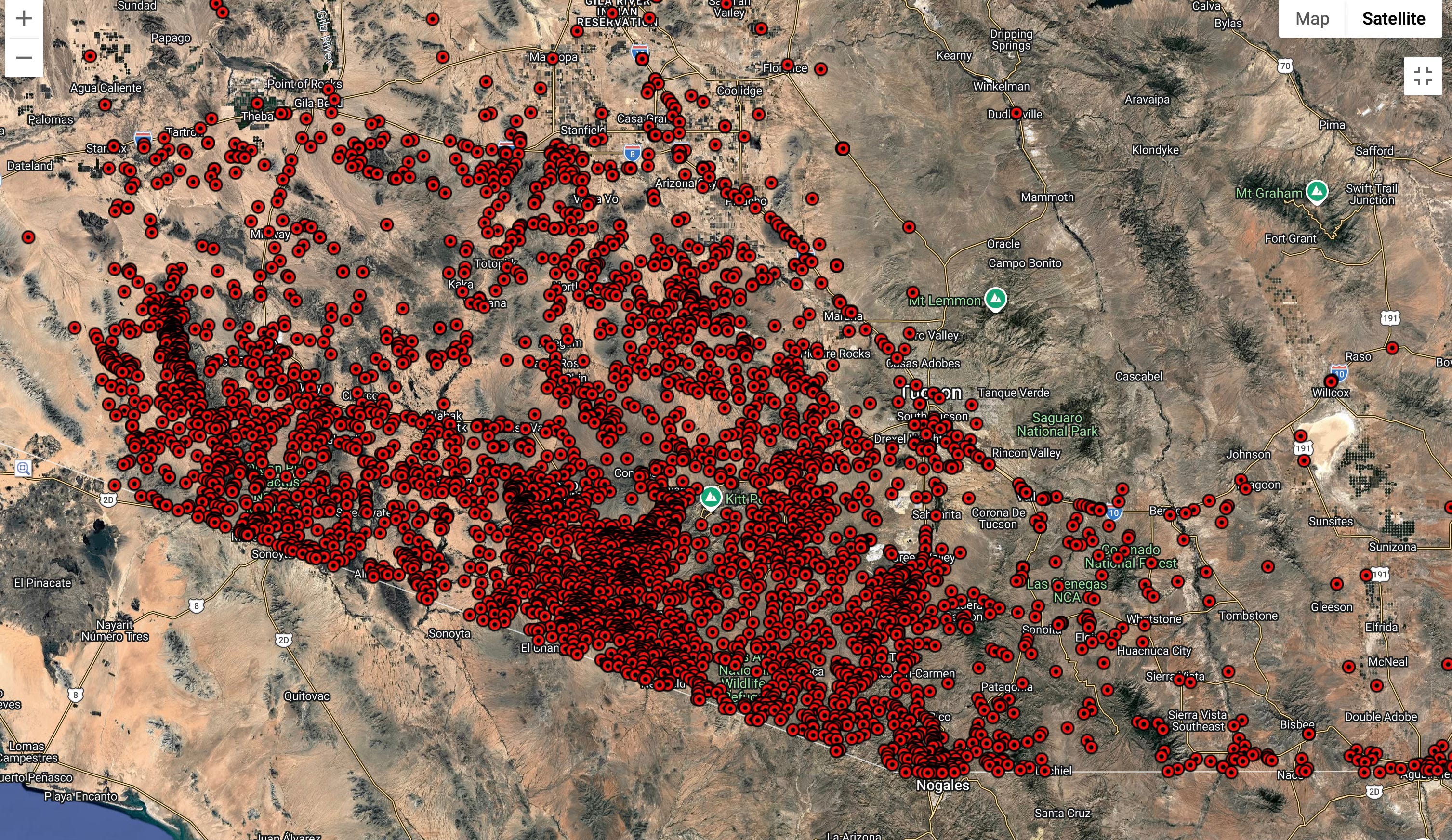
And unfortunately, you know, not everywhere along the border does a good job of this. But you all in the Tucson sector have really, it’s one of my most favorite places to go because of the people and the activism and the humanitarians. And the love and how you all just work together under such brutal conditions, quite honestly, out there in the desert.
What do you think is going to be, do you have any kind of ideas or thoughts of what you want to do in the near future with what’s going on? Or do you just keep hoping that...
Laurie: Yeah, I will say this, and just a quick note, the Pima Medical Examiner’s Office is the gold standard of data collection. They recently identified remains that were found in 2008. That’s how committed they are and bringing closure to families and loved ones. It’s a thankless job, right? But they do it so well.
And there is no national database of migrant deaths. The only one approaching it is the Border Patrol’s, but it’s undercounted by at least 50% because they don’t report if I or Humane Borders volunteer finds remains, that does not get reported to the Border Patrol. It goes to the medical examiner and is handled locally. So don’t trust those numbers. And the numbers in our database are just the tip of the iceberg, as you said, about who’s been found.
So what lies ahead? So for 26 years, we’ve been putting water in the desert religiously, you know, people of all ages, all backgrounds. They’re really dedicated to the mission. We’re a mostly volunteer organization, no federal funding whatsoever, and we’re powered by private donations. We’ve decided that it’s time in our history that doing water is great, but we need to do more. So this is where you’re going to be hearing from us speaking out more from a humanitarian lens, not, again, a righty-lefty kind of thing, but just this is wrong and from a fact-based. We’re bearing witness to what’s happening, and if you follow us on our social media platforms, you can see firsthand what it’s like at the border because we have eyes and ears all across the border for now putting water out there.
So you’ll be hearing more from us on an advocacy level. Again, not hysteria, not fear-mongering, but just stating facts, what we see, what we think. And our goal one day is to put ourselves out of business because we don’t have people dying by the dozens in our own backyard. So that would be my fondest dream to have a country where where I don’t have to be ashamed that we are the land of open graves in Arizona. So, we’re going to keep working toward that end.
Jenn: Yes, some people in the chat are asking your name. Her name is Laurie Cantillo, C-A-N-T-I-L-L-O of Humane Borders, and that’s humaneborders.org. So on your mainstream media today and probably forever, they’re just saying that, oh, yeah, the border’s sealed because nobody’s crossing and this and that.
Well, Laurie’s telling you that Pima County has found nineteen bodies in the month of July. So people are crossing. They’re just lying to you, but of course, nobody’s really covering it. They’re not really covering it down here.
I really, you know, this is close to my heart because I never had any idea when I joined that agency that I would be finding dead bodies out there and stuff like that. And usually I’m able to talk about it, you know, kind of keep a distance from it. But I wanted to tell you, when I came back from that El Paso trip, I had to do an interview for a documentary. I don’t know if it will ever come out or not, but it was supposed to be a couple hours, but it ended up being five hours. It was ridiculous. And I think it was just because I had just come back from a search for bodies, and the guy interviewing me kind of caught me off guard, and he asked me, you know, what kind of conditions they’re found in and how they die.
And I started to talk and all of a sudden I just, I couldn’t talk and I covered my face because I started sobbing. It’s going to make me cry now..
Laurie: Yeah, that’s an experience that no one should ever have of finding human remains. It’s happened to our volunteers. We have counseling available to people because it’s traumatic. And of course, we don’t show images of human remains, but the medical examiner does a regular public talk. I see people from Tucson here go to one of those talks because yes, it’s hard to see what it’s like, but I think it’s important that we know what’s happening. Sometimes it’s within twenty minutes of Tucson. It’s right next to a major roadway. They make it as far as that.
And dehydration and exposure is a terrible, terrible way to die. Your skin becomes almost mummified. It turns black. People become delirious. They may rip off their clothes and just go slouch against a small tree they can find in the desert and grab a rosary and think of their families. And then they perish.
I really feel - my heart goes out to our volunteers who have had that sobering experience. But it does connect us to the reason why we do this and why it’s so important to get up in the middle of the night and head out in the desert before it gets too hot so we can save lives.
So I really deeply appreciate the opportunity to talk about our work, and I hope that you will tell more people because we need to make the world aware of what’s happening.
Jenn: Yeah, and it’s intentional. It doesn’t have to be happening. We could have legal avenues with which people could cross where we could inspect them and we know who’s coming into our country, but they just don’t do it because they don’t want “those people” here. And because this system that they’ve created makes a lot of money. It makes a lot of money for all sorts of different people, whether they’re building the walls or, you know, And producing armaments and all the agents and all this other stuff.
And the sad thing, too, is so many agents I know are just completely mentally fucked up from this stuff. Most of them won’t admit it. You know, they act like they’ve gone to war or some shit. It’s like, you’re not at war. You’re a civil immigration officer. And you’re pushing, you’re enforcing laws that are pushing people to their deaths. So quit acting like you’re at war.
Is it a secondary trauma, a tertiary trauma? Yes, it is. And it does affect the agents. It affects the humanitarians. It affects the Pima County medical examiner who has to constantly go through all this. And it affects their families. But I mean, obviously, most of all, it affects them.
And I just...I think going out and volunteering with Laurie, she will take you to some of the crosses because there are crosses in very, very, very many spots out there that they’ve identified where they have found bodies and they can tell you the story of these people who died there.


And it is some of the most traumatic and horrible and painful deaths that you can ever imagine. To watch somebody go through this… will stay with you the rest of your life. So I want to thank you, Laurie, for doing this. Always being willing to put yourself out there and experience the secondary trauma that goes along with it. But, man, you always stay with it. You’re always out there. So I appreciate you.
Laurie: And we’re going to continue.
Jenn: And Joel. I love Joel. Please give Joel a big old kiss for me. And tell him hi. And I don’t know if Shark’s still with you, but let her know that, let everybody know that I said hello. Unfortunately, won’t be able to make it out there in the next couple weeks because that trip got canceled because the court case got canceled. But, you know, I’ll be back in Tucson, of course, because I’m always in Tucson.
Laurie: You’re always welcome, Jen. And thank you for adopting one of our water stations. That really means a lot to me and our volunteers. So, appreciate you for doing that. And thank you, everyone, for tuning in and learning more about this, you know, mostly invisible issue.
Jenn: Thank you, everybody. Have a good night.